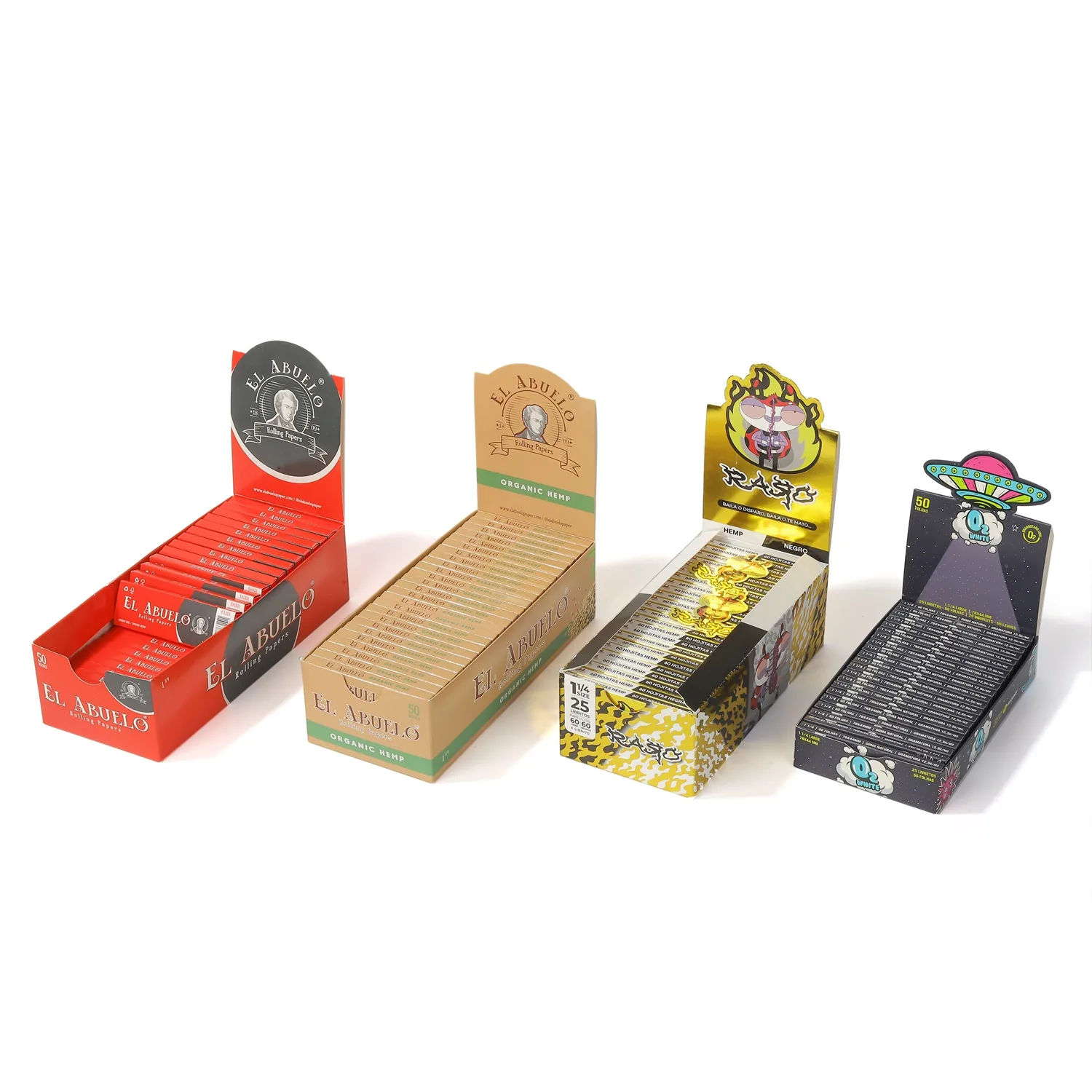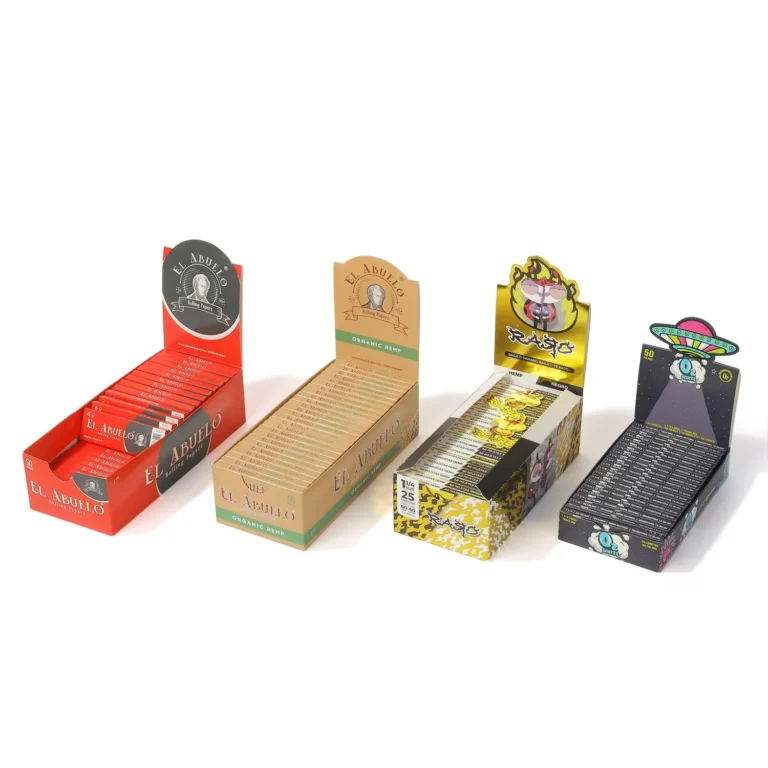

You run a smoke shop. Glassware sits on the shelf for months. Grinders move slowly. But rolling papers and cones fly off the rack every week. Your best customers come back for paper, not pipes. Yet most retailers treat accessories as an afterthought.
Paper-based smoking accessories — rolling papers, cones, and filter tips — drive the highest turnover and strongest repeat visits in a smoke shop. They take up minimal shelf space, carry better margins than many hardware items, and offer private-label opportunities that glassware cannot match.
This article explains what accessories actually matter for retailers, how to evaluate quality, and how to build a product mix that brings customers back weekly.

What Counts as a Smoking Accessory?
Smoking accessories fall into two broad categories:
Paper-based accessories are consumable, single-use or limited-use items: rolling papers, pre-rolled cones, filter tips, blunt wraps, and rolling trays. These products have high purchase frequency and strong brand loyalty once a customer finds a product they prefer.
Hardware-based accessories are durable goods: lighters, grinders, glass pipes, water pipes, vaporizers, and storage containers. These have lower purchase frequency but higher per-unit margins.
For retailers, the paper-based category deserves disproportionate attention for three reasons. First, customers who buy papers or cones return more frequently than those who buy hardware. Second, paper accessories occupy less shelf space per dollar of revenue than bulky glassware. Third, paper products offer more private-label and customization opportunities than hardware, which is dominated by established brands with rigid distribution agreements.
What Should Retailers Know About Rolling Papers?
Rolling papers are the oldest and most consistent seller in the smoking accessories category. Despite decades of product innovation, the basic format — thin paper sheets in a folded booklet — remains unchanged. What has changed is the material science behind the paper.
Matériaux
The base fiber determines burn rate, taste, ash color, and environmental positioning:
Pâte de bois is the most common material. Refined white wood-pulp papers offer the most neutral taste and slowest, most predictable burn. Unbleached wood-pulp papers appeal to consumers who want a “less processed” product. Both varieties rely on responsible sourcing, which is why FSC certification matters for credibility.
Hemp fiber contains approximately 85 percent cellulose compared to 30 percent in wood pulp. This produces a stronger paper at lower basis weight, meaning it can be thinner without tearing. Hemp also grows in roughly four months versus twenty years for trees, making it the default choice for sustainability-focused brands.
Rice paper is made from processed rice straw. It is extremely thin with minimal taste interference. The tradeoff is fragility. Rice paper works best for experienced users who handle papers gently, or for brands that position around purity and flavor preservation.
Flax and bamboo are emerging as premium alternatives. Flax, in particular, offers a tree-free, biodegradable option with excellent burn characteristics. Bamboo grows rapidly and requires no pesticides, appealing to environmentally conscious consumers.
Tailles
Rolling papers are sold in standardized sizes, though exact dimensions vary by manufacturer:
| Size Name | Typical Dimensions | Idéal Pour |
|---|---|---|
| Simple large | 68–70 mm x 36 mm | Quick, personal sessions |
| 1 1/4 | 78–84 mm x 44–47 mm | Standard single serving |
| Format king size | 100–110 mm x 53–55 mm | Extended sessions |
| King Slim | 105–110 mm x 42–44 mm | Longer, thinner rolls |
Retailers should stock at least three sizes: 1 1/4 as the default, King Size for experienced users, and Single Wide for price-sensitive customers or sample packs.
Bleached vs. Unbleached
Bleached white papers use chlorine or oxygen-based processes to remove lignin and achieve a clean appearance. The best bleached papers use elemental chlorine-free (ECF) or totally chlorine-free (TCF) processes. Unbleached papers retain more natural fiber content, giving them an earthy color and slightly more textured feel. Both are safe when produced by reputable manufacturers. The choice is primarily a matter of consumer perception and brand positioning.
Why Are Pre-Rolled Cones Growing So Fast?
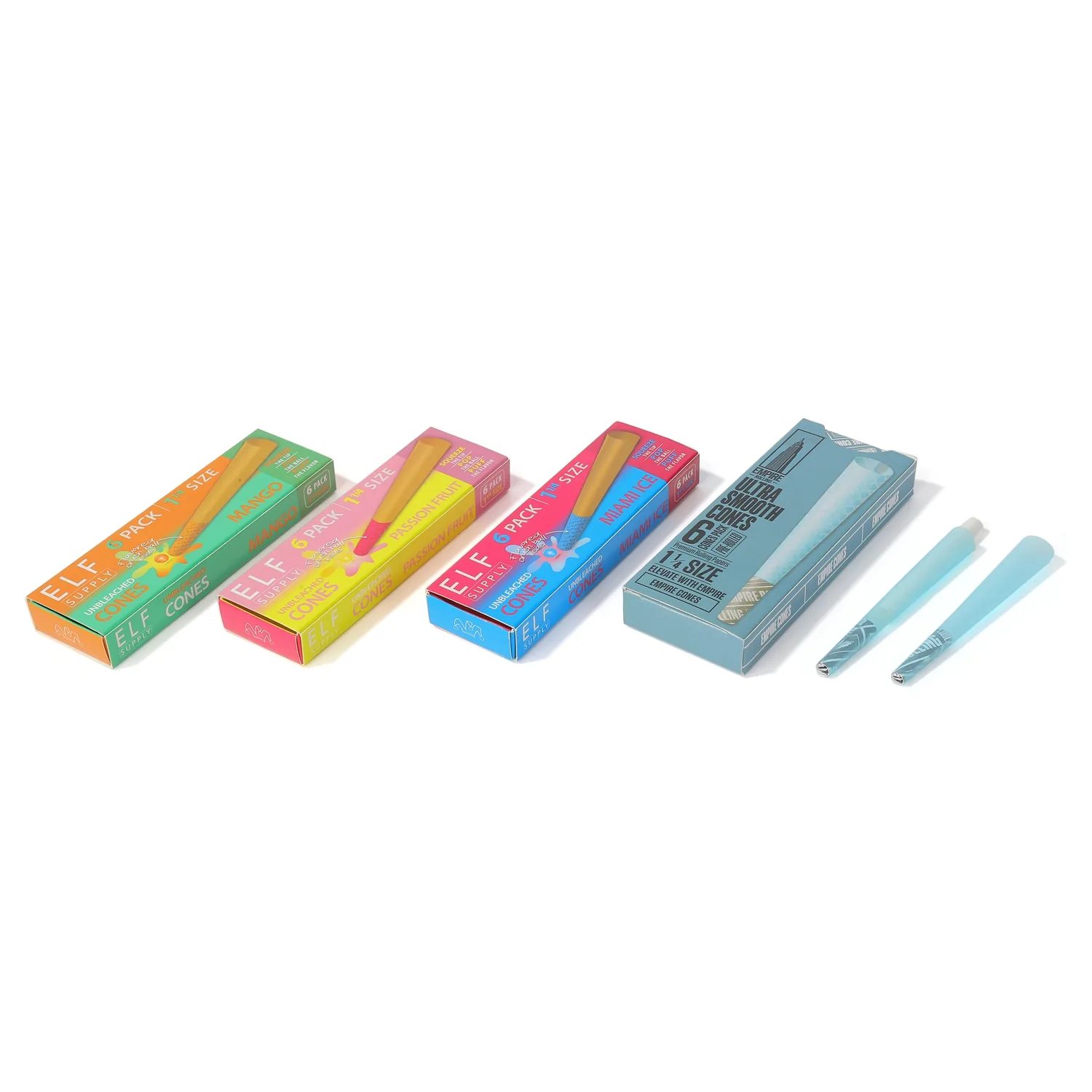
Pre-rolled cones have grown from a niche convenience product into the dominant format in many markets. A cone is a pre-shaped, tapered paper tube with a filter tip already attached. The user simply fills it, twists the top, and the product is ready.
This format eliminates the skill barrier of hand-rolling, which is why it appeals to casual consumers and medical users. For retailers, cones also reduce the “how do I roll this?” customer service burden.
Size Options
| Size Name | Typical Length | Typical Diameter | Idéal Pour |
|---|---|---|---|
| Mini | 60–70 mm | 18–20 mm | Quick sessions, sample packs |
| 1 1/4 | 78–84 mm | 20–22 mm | Standard single serving |
| Slim | 98–100 mm | 18–20 mm | Longer, thinner draw |
| Roi | 109–110 mm | 20–26 mm | Extended sessions, sharing |
| Party | 130–140 mm | 22–26 mm | Group use, special occasions |
The 1 1/4 and King sizes are the safest starting stock for most retailers. Slim sizes appeal to experienced users who prefer cooler draws. Mini sizes work well for low-dose products and sampler configurations.
Filter Tip Variations
The filter tip is the only part of the cone that touches the user’s mouth, making it a critical quality and branding element:
- Paper tips are the standard. Cost-effective, biodegradable, and printable with brand logos.
- Wood tips add tactile weight and can be laser-engraved. They absorb less moisture than paper, keeping the mouthpiece dry.
- Glass tips are reusable and non-porous. They offer the purest flavor but are fragile and best suited for premium single-cone products.
- Ceramic tips combine non-porous cleanliness with better durability than glass. They are the heaviest option and signal luxury positioning.
What Filter Tips Should Retailers Stock?
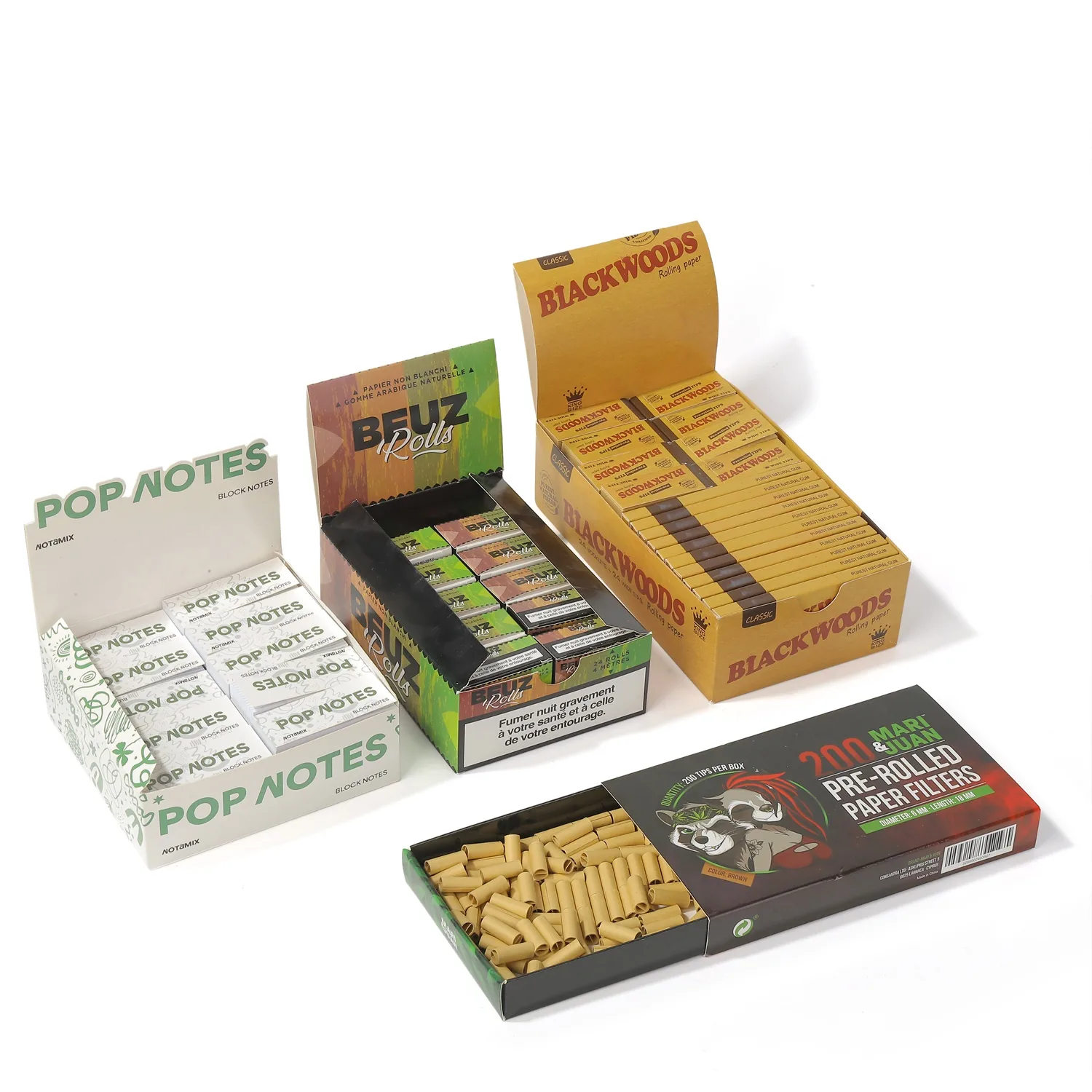
Beyond cones, standalone filter tips are a significant accessory category. Pre-cut paper tips come in standard or perforated varieties. Perforated tips allow users to create a spiral or “W” shape inside the tip, which cools smoke and catches debris more effectively.
Glass and ceramic filter tips are increasingly sold as reusable accessories that customers pair with papers or cones of their choice. These have high margins and strong gift appeal, making them valuable add-on items at checkout.
Do Rolling Trays and Storage Matter?
Rolling trays are functional display pieces. A customer who owns a branded tray sees that brand multiple times per week, which builds loyalty. Metal trays are durable and printable with vibrant designs. Wood trays offer a premium, organic feel. Silicone trays are unbreakable and easy to clean.
Storage solutions include glass jars with humidity control, airtight metal tins, and UV-protective containers. Humidity control is critical for product quality, and many consumers do not own proper storage. Retailers who bundle papers or cones with a small storage container create a higher perceived value than selling either item alone.
How Should Retailers Test Accessory Quality?
Not all smoking accessories are manufactured to the same standard. Before adding a product line to your inventory, evaluate the following:
Consistance des Matériaux
Request samples from at least three different production batches. Check for variations in color, texture, and thickness. Significant variation indicates poor raw-material sourcing or inadequate process control.
Gum-Line Adhesion
The adhesive strip must hold firmly when moistened but must not activate prematurely in humid conditions. Natural Arabic gum is the industry standard. Test the gum by licking and sealing a paper, then gently pulling. It should hold under moderate tension.
Burn Rate Uniformity
A quality paper or cone burns from end to end at a consistent rate. “Canoeing” — where one side burns faster — is usually caused by uneven paper porosity. Test burn several samples and reject suppliers whose products show frequent uneven burning.
Packaging Integrity
Booklets should open and close cleanly without tearing at the fold. Cones should arrive intact, not crushed, with filter tips securely attached. Outer packaging should protect against moisture and physical damage during shipping.
Compliance Documentation
For wood-pulp papers, request FSC certification. For any product sold in regulated cannabis markets, request heavy metal, pesticide, and microbial testing documentation. Even in unregulated markets, having these documents signals professionalism and protects your business from future liability.
| Quality Check | What to Look For | Red Flags |
|---|---|---|
| Material consistency | Same color/texture across batches | Visible variation, spots, or thin areas |
| Gum adhesion | Strong seal, no premature activation | Weak seal, gummy residue, chemical smell |
| Burn rate | Even burn, no canoeing | Side-burning, fast uneven ash |
| Emballage | Clean folds, intact cones | Crushed tips, torn booklets, moisture damage |
| Documentation | Current certs, batch traceability | Expired certs, vague claims |
What Does Your Accessory Selection Say About Your Store?
The accessories you stock shape how customers perceive your business. A smoke shop that carries only the cheapest papers and lighters signals a discount positioning. A dispensary that curates premium cones with wood tips, branded trays, and humidity-controlled storage signals expertise and quality.
The bundling opportunity is often overlooked. A customer buying flower is already in purchase mode. Offering a bundle — premium cones, a quality grinder, and storage — increases average transaction value while solving problems the customer may not have considered. The retailer who thinks in systems (flower + paper + storage) outsells the retailer who thinks in individual SKUs.
What Mistakes Do Retailers Make?
- Stocking only well-known brands without testing alternatives: National brands have recognition, but they also have thin margins. Private-label and emerging brands often offer better wholesale terms and exclusivity.
- Ignoring the unbleached and organic trend: A growing segment of consumers specifically seeks unbleached, organic, or hemp-based products. Not stocking these options means leaving revenue on the shelf.
- Not offering size variety within cone categories: Stocking only one cone size ignores the reality that different consumers prefer different experiences. At minimum, offer 1 1/4 and King.
- Overlooking filter tip options: Filter tips are a high-margin add-on with low shelf-space requirements. Not displaying them near cones is a missed opportunity.
- Missing the bundling opportunity: Accessories purchased together create higher perceived value and stronger customer loyalty than accessories purchased separately.
À propos d'Ace Rolling
Ace Rolling est Guangdong Ace Rolling New Material Technology Co., Ltd. — one of only two RYO paper factories operating at this scale anywhere in the world. We manufacture the full range of paper-based smoking accessories: custom rolling paper booklets, pre-rolled cones in all standard sizes, premium filter tips in paper, wood, glass, and ceramic, and complete retail packaging solutions.
Manufacturing Scale
Notre installation de 2 000 à 4 000 m² à Dongguan, en Chine, fonctionne avec une production entièrement automatisée sur 5 à 7 lignes haute vitesse de norme internationale et 17 machines principales. La capacité annuelle atteint 500 millions de carnets et cônes. We are also the seul fabricant de l'industrie capable of customizing booklets up to 120 feuilles par carnet using advanced high-speed precision slitting equipment.
Contrôle des Matériaux
Chaque feuille que nous produisons commence par du papier de base provenant de Mudanjiang Hengfeng Paper Co., Ltd. (Groupe Hengfeng) — the world’s third-largest specialty and smoking paper enterprise, commanding one-third of global smoking paper market share. This exclusive supply relationship gives us material stability and full traceability.
Certifications
- ISO 9001:2015 — systèmes de gestion de la qualité
- FSC (Forest Stewardship Council) — approvisionnement responsable
- Fournisseur Vérifié Alibaba — audited on-site by TÜV Rheinland / SGS
Material Innovation
Beyond standard hemp, rice, and wood pulp, we offer:
- Pandace pure flax — the world’s first 100% tree-free, biodegradable rolling paper
- Authentic bamboo paper — fast-growing, low-impact fiber
- Rose petal wraps — botanical alternative for ultra-premium positioning
- Cellulose transparente — transparent paper for visual-forward products
Tous les papiers utilisent 100% gomme arabique naturelle organique sans aucun additif chimique nocif. Chaque lot est testé pour la porosité dynamique, le taux de combustion lente et la pureté des cendres.
Deux Modèles Commerciaux
Que vous ayez besoin produits de détail entièrement finis sous nos quatre marques déposées, ou personnalisation OEM/ODM approfondie built from scratch — from laser-engraved wood tips to custom watermarks and branded packaging — the same quality control applies.
Amazing Paper, Create, Enjoyable Life! — Ace Rolling
Questions Fréquemment Posées
What smoking accessories have the highest turnover in retail?
Rolling papers and pre-rolled cones have the highest purchase frequency. A regular consumer may buy papers or cones weekly or bi-weekly, whereas hardware like grinders or pipes is purchased only occasionally. Filter tips and rolling trays are strong add-on items with good margins.
Should retailers stock bleached or unbleached papers?
Stock both. Bleached white papers remain the default choice for mainstream consumers. Unbleached papers are growing in popularity among health-conscious and environmentally aware buyers. Offering both signals that you understand your customer base.
What cone sizes should every smoke shop carry?
At minimum, 1 1/4 and King Size. These two sizes cover approximately 80 percent of consumer preference. Add Slim if your customer base includes experienced users, and Mini for sample packs or low-dose products.
Are glass filter tips worth stocking?
Glass tips are a niche premium product, but they have excellent margins and strong gift appeal. They work best as a curated add-on near the register rather than a core inventory item. Consider them if your store serves a premium or gift-buying demographic.
How can retailers differentiate with private-label accessories?
Private-label rolling papers and cones allow you to build brand equity directly. Unlike hardware, which is dominated by established brands, paper accessories can be manufactured to your specifications with custom packaging, sizes, and materials. The minimum order quantities are lower than most retailers assume.
Final Thoughts
Smoking accessories are not an afterthought. They are the products that bring customers back repeatedly, that occupy the least shelf space for the revenue they generate, and that offer the most customization potential for retailers who want to build their own brand. The retailers who treat accessories as a strategic category — curating quality, offering variety, and bundling intelligently — will outperform those who treat them as commodity filler.
Looking to develop your own line of smoking accessories? Ace Rolling offers factory-direct manufacturing for rolling papers, pre-rolled cones, filter tips, and complete retail packaging — with customization starting at quantities accessible to independent retailers and growing brands.