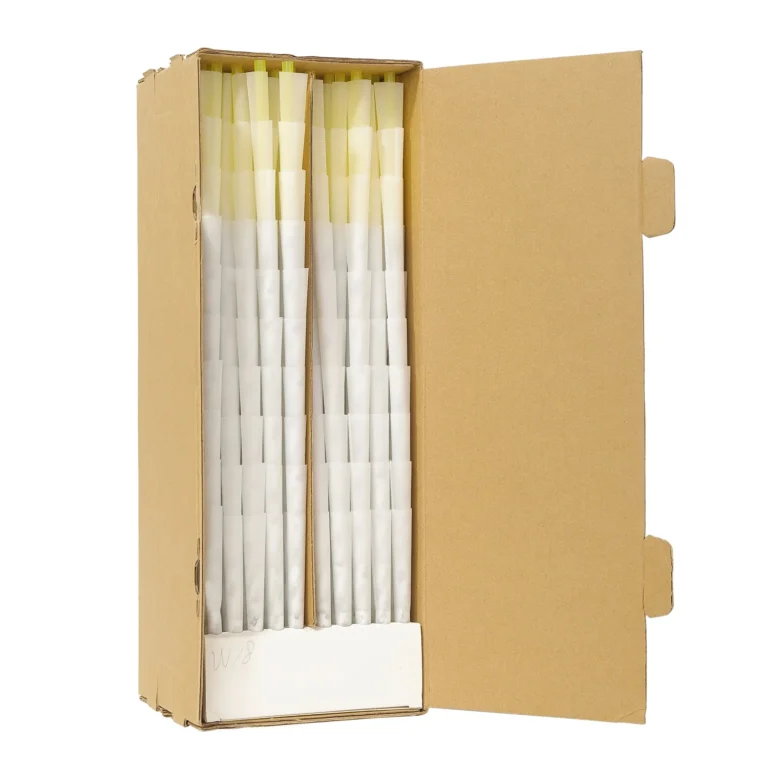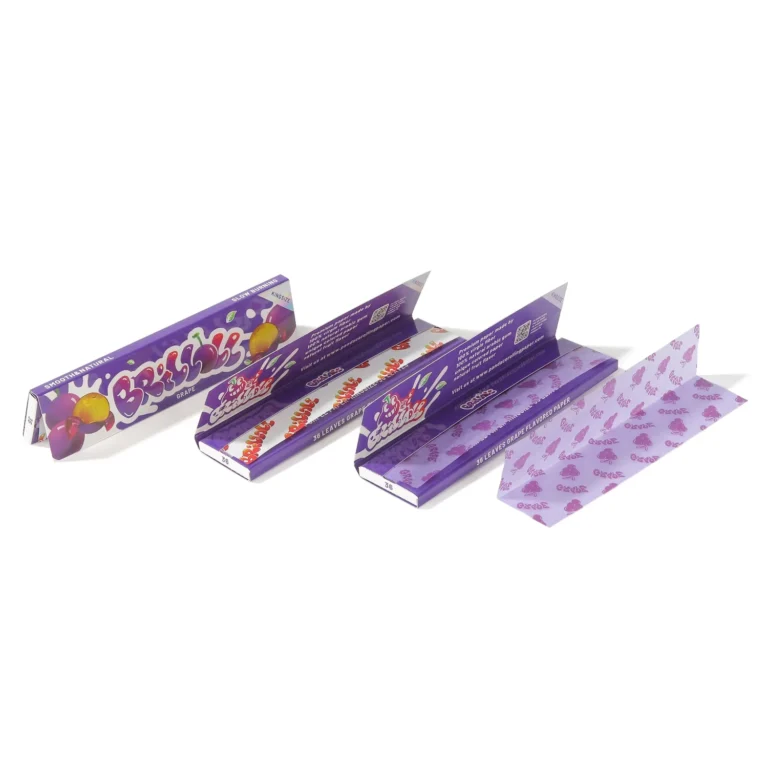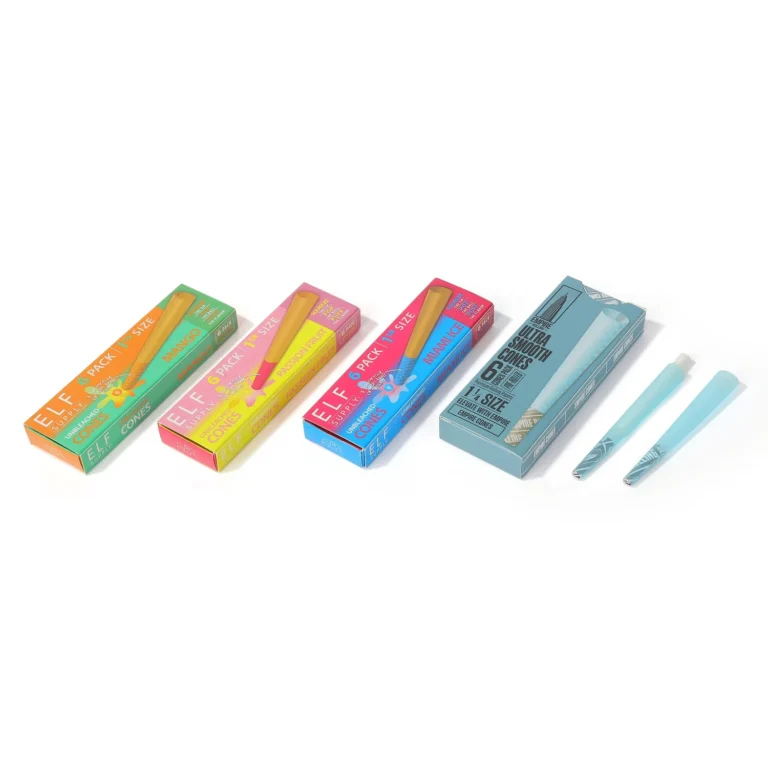

Spot UV adds clear gloss to selected printed areas; embossing presses the paperboard between dies to create physical relief. Used together, they can make a logo shine and rise—but custom rolling paper buyers must align artwork, stock, folds, registration, samples, and quote scope before production.
For booklet covers and retail cartons, “spot UV embossing” is really two finishing operations, not one universal process. Custom Cones USA presents spot UV and embossing as market upgrade options for custom rolling paper packaging; Ace Rolling buyers should treat availability, sequence, tolerances, and pricing as project-specific and quote-dependent.
How Do Spot UV and Embossing Work Step by Step?
The finish starts in prepress, not at the coating or embossing machine. A printer needs the structural dieline, base artwork, and separate masks showing exactly where gloss and relief belong.
In a typical workflow, the packaging is printed, any specified surface layer is applied, embossing dies shape selected areas, and clear UV varnish is registered to the approved spot mask and cured. The exact finishing order can change with the stock, coating system, artwork, and converter, so buyers should approve the proposed sequence in writing.
| Этап | Что происходит | Buyer approval |
|---|---|---|
| Structure | Booklet cover or carton dieline is locked | Size, folds, glue areas |
| Base print | CMYK and approved spot colors are printed | Color and copy |
| Embossing | Matched dies press relief into the board | Height, edge definition, reverse-side effect |
| Выборочное УФ-лакирование | Clear varnish is placed on selected areas | Gloss location and registration |
| UV cure | Ultraviolet energy hardens the varnish | Surface consistency |
| Conversion | Sheets are die-cut, folded, assembled, and packed | No cracking or finish damage |
The important control point is registration: the gloss mask, embossing mask, printed logo, and physical cut must all reference the same approved dieline. Packaging guides such as the first organic result for this question describe the same selective-varnish principle. For an Ace project, confirm the actual route through https://ace-rolling.com/oem-odm-rolling-paper-manufacturer/.
Ключевой вывод: Lock one dieline and two separate finish masks before asking the factory to combine gloss and relief.
Is Spot UV the Same as Embossing or Raised UV?
These terms are often bundled in sales language, but they do different jobs. Standard spot UV changes reflected light; embossing changes the shape of the paperboard.
Raised UV builds varnish above the surface through a suitable digital embellishment process, while true embossing mechanically deforms the stock with dies. On direct-printed paper packaging, buyers should not assume ordinary spot UV will feel like embossing. Ask for a labeled physical sample rather than judging from a rendered highlight.
| Finish | Main effect | Tooling | Best buyer question |
|---|---|---|---|
| Выборочное УФ-лакирование | Selective clear gloss | Screen or digital coating setup | Where will gloss appear? |
| Embossing | Paperboard raised from its plane | Matched metal dies | How will relief affect folds and the reverse side? |
| Debossing | Paperboard pressed inward | Metal dies | Is recessed depth compatible with the pack? |
| Raised UV | Varnish builds tactile height | Digital embellishment capability | Is this process available on the chosen stock? |
Market suppliers, including Custom Cones USA, advertise spot UV and embossing as optional booklet upgrades. That establishes them as market options, not automatic Ace capabilities or specifications. Discuss the desired visual effect with https://ace-rolling.com/custom-rolling-papers/ and let the quotation define the production method.
Ключевой вывод: Specify the effect you need—shine, physical relief, recess, or varnish height—instead of writing only “spot UV embossing.”
Should You Combine the Finishes on Booklets or Cartons?
Combining both finishes makes the most sense when one important element deserves a visual and tactile focal point. A logo, short product name, or restrained pattern usually gives the converter a clearer registration target than a cover full of tiny coated details.
Booklet wrappers have folds, moving flaps, and frequent handling. Cartons offer larger panels but add scores, glue seams, and assembly pressure. Keep critical embellishment away from structural stress unless the physical proof shows that the design survives folding and packing.
| Packaging surface | Strong use case | Основной риск | Practical choice |
|---|---|---|---|
| Booklet front | Logo or short brand name | Fold cracking and tight registration | Small, focused finish zone |
| Booklet flap | Closure cue or compact mark | Repeated flexing | Proof after repeated opening |
| Retail carton front | Hero logo or product line | Rub during packing and transit | Protect key areas from seams |
| Carton side panel | Variant or texture pattern | Score-line interference | Keep masks clear of folds |
| Display panel | Shelf-facing brand cue | Lighting glare | Test under retail-style light |
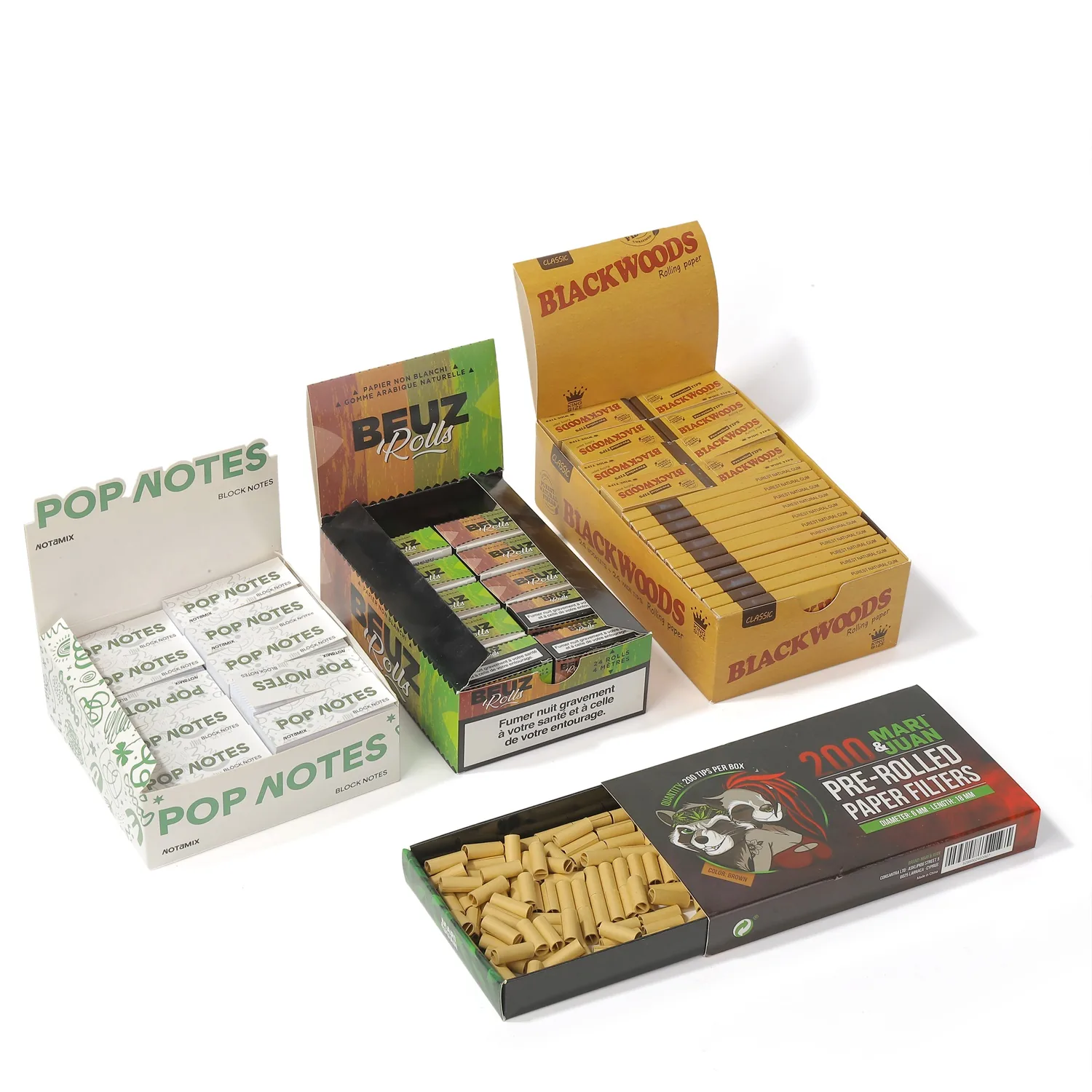
Ace Rolling supports custom rolling paper booklets and retail packaging from Dongguan, China. The right finish map depends on the real structure, so send both booklet and carton dielines when discussing https://ace-rolling.com/custom-rolling-papers/.
Ключевой вывод: Use the combined effect once where it matters most, then protect folds, scores, glue zones, and high-rub edges.
What Artwork Files Does an OEM Factory Need?
A glossy mockup is not production artwork. Prepress needs a base print file plus clean vector information for every special operation.
Keep the CMYK design intact, then create a spot UV mask and an embossing mask at exactly the same page size and position. Solid black normally indicates treated areas in finish-mask files, but the factory’s live specification controls naming, overprint settings, clearances, and minimum feature size. Outline fonts and remove accidental transparency from masks.

| File or layer | Must show | Must not contain |
|---|---|---|
| Structural dieline | Cut, fold, score, glue, safe areas | Unapproved size changes |
| Base print | Final CMYK artwork and approved spots | Hidden draft copy |
| Spot UV mask | Only areas receiving clear varnish | Gradients unless specifically approved |
| Embossing mask | Exact areas intended for relief | Unrelated print objects |
| Reference PDF | Labeled visual of the intended result | Effects used as production geometry |
Ask Ace Rolling for the current template before your designer separates masks. The OEM workflow at https://ace-rolling.com/oem-odm-rolling-paper-manufacturer/ is best treated as brief → sample → sign-off → scale, with the finishing files locked during sign-off.
Ключевой вывод: Submit editable vector geometry for each finish; do not make the printer reverse-engineer masks from a visual mockup.
Which Paperboard and Surface Choices Matter Most?
Spot UV and embossing depend on the substrate beneath them. A finish that looks sharp on one coated board can register, fold, or reflect differently on another.
The buyer should approve the actual board, printed color, surface treatment, and assembled pack together. Matte backgrounds often create stronger contrast with gloss, while emboss depth depends on board behavior and structure. FSC-certified sourcing can be discussed as an option for appropriate Ace programs, but it is not automatic for every component or order.
| Решение | Spot UV impact | Embossing impact | What to sample |
|---|---|---|---|
| Matte surface | Can increase gloss contrast | May show pressure marks clearly | Finished front panel |
| Gloss surface | Lower contrast with clear gloss | Relief remains tactile | Angled-light comparison |
| Board stiffness | Influences coating handling | Influences relief definition | Folded, assembled pack |
| Dark ink coverage | Can reveal dust or coating defects | Can emphasize edge shadows | Production-color proof |
| Recycled/FSC option | Confirm coating compatibility | Confirm fiber response | Exact sourced board |
Ace Rolling operates within an ISO 9001:2015 management framework and can discuss FSC-certified sourcing options for suitable projects. Request documentation and material scope through https://ace-rolling.com/quality-certifications/ rather than placing unsupported certification claims on the artwork.
Ключевой вывод: Approve embellishment on the exact board and surface treatment that will enter mass production.
How Should Buyers Proof Registration and Durability?
Digital proofs can catch spelling, placement, and missing masks, but they cannot prove gloss, relief, fold behavior, or the feel of an assembled booklet.
Use a physical finishing sample whenever spot UV and embossing are decision-critical. Inspect the sample in direct and angled light, touch the relief, open the booklet repeatedly, fold the carton, and compare the finished item with the approved reference. Retain a signed sample for mass-production comparison.

| Контроль качества | Pass condition | Common failure signal |
|---|---|---|
| Print-to-UV registration | Gloss follows approved art | Halo or shifted edge |
| Print-to-emboss registration | Relief centers on intended element | Doubled-looking logo |
| Varnish surface | Even cure and gloss | Pinholes, bubbles, dull patches |
| Emboss definition | Clean edge and consistent relief | Crushed or soft detail |
| Fold test | No unacceptable cracking or lifting | Damage along score |
| Pack-out test | Finish survives assembly and handling | Scuffing at contact points |
Ace buyers can use https://ace-rolling.com/about-factory/ to frame production and QC questions, then put finish acceptance criteria directly on the specification and approved sample.
Ключевой вывод: A screen proves layout; only the finished physical pack proves gloss, relief, registration, and fold performance.
How Do Spot UV and Embossing Affect OEM Cost and Timing?
Both finishes add setup, process steps, proofing, and inspection. Embossing may require dedicated dies; spot UV requires a coating mask and registered application. Combining them can increase risk and handling even when the treated area is small.
Ace does not publish a fixed spot UV or embossing surcharge, so the finish price is quote-dependent. Approved factory wholesale planning ranges are about USD $0.07–$0.30 per custom booklet and about $0.04–$0.06 per cone, with MOQ applying. A special-finish retail pack may quote differently depending on structure, material, print, finish area, quantity, and pack-out.

| Cost or schedule driver | Why it changes the quote | What to send |
|---|---|---|
| Separate finish masks | Adds prepress review | Final vector files |
| Embossing dies | Adds tooling and setup | Approved relief geometry |
| Finish coverage | Changes coating and inspection scope | Marked treatment area |
| Booklet plus carton | Creates multiple structures | Both dielines |
| Physical proof rounds | Adds approval gates | One decision owner |
| Quantity and pack-out | Changes unit economics and handling | Forecast and carton plan |
Ace OEM programs often start around 2,000 units, depending on size, material, printing, packaging, and quantity. Planning is commonly about two months from concept to delivery, with mass production often around four to five weeks after specs and proofs are approved. Confirm finish-specific dates and prices through https://ace-rolling.com/custom-rolling-papers/.
Ключевой вывод: Never estimate the finish surcharge yourself—quote the exact masks, board, structures, quantity, proof scope, and destination.
What Should You Send Ace Rolling for a Finish Quote?
A useful RFQ describes the product and the embellishment as one manufacturing system. “Premium cover with spot UV embossing” is too vague for reliable costing.
Send the booklet size, leaf count, paper route, cover and carton structures, dielines, base artwork, separate finish masks, estimated quantity, destination, and target timing. State whether you want selective shine, physical relief, or both, and identify every panel receiving treatment.
| RFQ field | Example of a useful instruction | Why Ace needs it |
|---|---|---|
| Продукт | Custom booklet and matching retail carton | Defines structures |
| Finish intent | Gloss logo plus embossed brand name | Separates effects |
| Дизайн | Base PDF plus labeled vector masks | Enables prepress review |
| Материал | Requested board and FSC sourcing option | Enables material check |
| Quantity | Launch quantity and reorder estimate | Frames MOQ and costing |
| Logistics | Destination country or port | Frames delivery planning |
| Approval | Physical finish sample required | Defines proof gate |
Review Ace Rolling’s https://ace-rolling.com/custom-rolling-papers/ options, then request a project-specific quotation at https://ace-rolling.com/contact/. Include packaging size, artwork status, finish map, quantity, destination, required documents, and target launch window.
Ключевой вывод: The fastest quote comes from a complete structural and finish brief—not a screenshot of a shiny logo.
Часто задаваемые вопросы
What is spot UV on paper packaging?
Spot UV is a clear varnish applied only to selected areas of printed paper packaging and cured with ultraviolet energy. On a rolling paper booklet, it can make a logo or pattern reflect more light than the surrounding surface. Standard spot UV should not automatically be described as physically embossed.
How does embossing work on a rolling paper booklet?
Embossing presses the booklet cover stock between matched dies so a selected logo, word, or pattern rises from the surrounding surface. The stock, design detail, folds, and reverse-side appearance affect the result. Buyers should approve an assembled physical booklet before authorizing the OEM mass-production run.
Can spot UV and embossing be used together?
Spot UV and embossing can be combined when the printer can register the printed art, relief, and clear varnish on the chosen paperboard. The result can add shine and physical depth to the same element. Availability, process order, tolerances, tooling, and price must be confirmed for the specific Ace quotation.
Is raised spot UV the same as embossing?
Raised spot UV and embossing are not the same process. Raised UV builds tactile height with cured varnish, while embossing mechanically reshapes the paperboard with dies. Standard spot UV may mainly add shine on direct-printed packaging. Ask the supplier to label physical samples so the requested effect is unambiguous.
How much does spot UV embossing cost at Ace Rolling?
Ace Rolling does not publish a fixed spot UV or embossing surcharge; special-finishing cost is quote-dependent. Custom booklet factory pricing generally plans around USD $0.07–$0.30 with MOQ, while exact packaging cost depends on board, structure, finish area, tooling, proofing, quantity, pack-out, and delivery terms.
What files should I send for an OEM packaging quote?
Send the current booklet or carton dieline, final base artwork, a separate vector spot UV mask, a separate vector embossing mask, material preference, quantity, and destination. Also identify treated panels and whether a physical finish sample is required. Ace Rolling can then confirm feasibility, MOQ, timing, and quote-dependent cost.