
For international B2B buyers, distributors, and brand owners, the transit phase is one of the highest-risk nodes in the rolling paper supply chain. Specialty paper items, especially organic hemp and refined rice papers, are highly hygroscopic (moisture-absorbent). When shipping bulk cargo over long-distance maritime routes, exposure to high humidity and temperature fluctuations can destroy entire shipments before they reach port.
To protect your inventory from moisture damage, your manufacturer must utilize engineered rolling paper bulk shipping packaging configurations that seal out water vapor. Sourcing papers packed with primary vacuum barriers, food-grade desiccants, and container-level condensation absorbents prevents paper wrinkling and adhesive activation during transit.
Understanding the physics of container condensation (“container rain”), water vapor transmission rates (WVTR), and pallet-wrapping standards will safeguard your cash flow and ensure retail-ready delivery.
—
What is “container rain” and why is it fatal for specialty papers?
During ocean transit—such as shipping from manufacturing hubs in Asia across the equator to ports in South America or Europe—cargo containers experience severe temperature variations. High daytime temperatures cause moisture to evaporate from the cargo and wooden pallets, saturating the air inside the steel container.
When the temperature drops rapidly at night, the saturated air reaches its dew point, condensing into water droplets on the cold ceiling and walls of the container. This phenomenon is known as container rain:
- Paper Warping: Excess moisture absorption causes natural plant fibers (cellulose) to swell. Because fibers align mainly in the machine direction, this moisture absorption results in uneven expansion and severe edge-wrinkling.
- Glue Activation: Natural Arabic gum is water-soluble. High humidity (above 65% RH) can liquefy the adhesive gum line, causing adjacent booklets or sheets to fuse together into a solid block.
- Microbial Growth: Prolonged exposure to moisture and warmth inside the container creates a breeding ground for mold and mildew spores.
—
The three-layer physical packaging defense line
To guarantee that bulk orders of booklets and pre-rolled cones arrive in pristine condition, premium OEM manufacturers implement a multi-stage defensive packaging strategy:
Layer 1: Primary Vacuum Barrier (Industrial Bags)
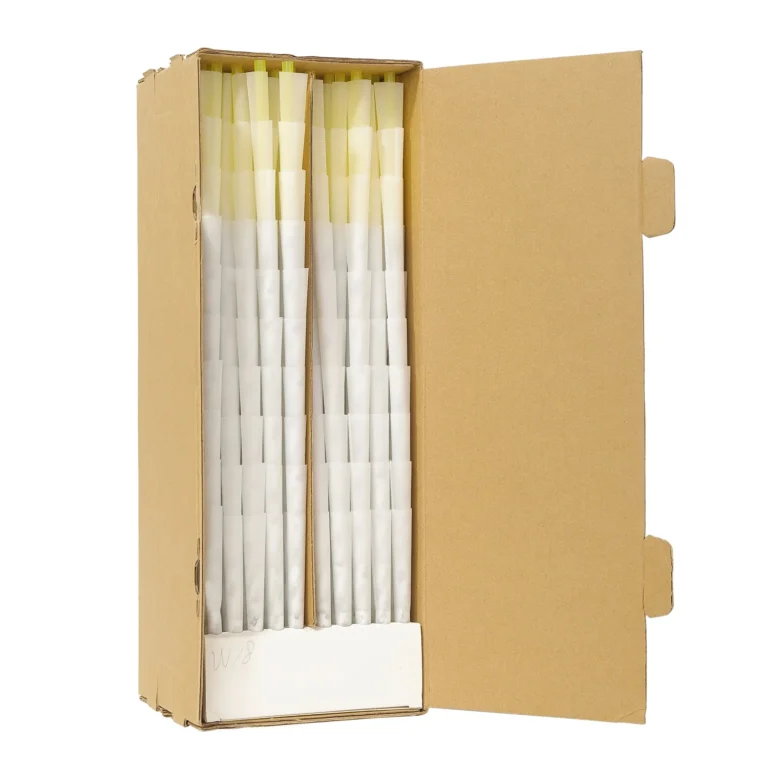
Booklet boxes and bulk cone cartons are sealed within heavy-duty aluminum composite foil bags. These vacuum-sealed bags feature a Water Vapor Transmission Rate (WVTR) close to zero, creating an airtight barrier that isolates the product from the external atmosphere.
Layer 2: Micro-Environment Desiccants
Inside each vacuum bag, engineers place precise quantities of food-grade desiccant packets (such as silica gel or active clay/montmorillonite). These active clay packets absorb any residual humidity remaining inside the bag, maintaining the paper’s optimal moisture window of 4.5% ± 1.5%.
Layer 3: Container-Level Protection and Pallet Wrapping
To prevent crushing and external moisture ingress, shipping boxes are stacked onto pallets and wrapped securely with heavy-duty stretch film.

Additionally, high-capacity desiccant poles containing calcium chloride (CaCl2) are hung along the interior walls of the container. These poles absorb up to 300% of their own weight in moisture, trapping the vapor as a solid gel and preventing it from condensing on the ceiling.
—
Sourcing Secure Logistics with Ace Rolling
Ace Rolling operates a 4,000 square meter ISO9001-certified factory floor. Leveraging the transport safety experience of state-owned parent company Hengfeng Paper, we enforce strict shipping packaging standards for all B2B orders:
- Redundant Moisture Barriers: Standard export orders utilize three layers of protection, including vacuum-sealed aluminum bags and container desiccants.
- Heavier Cardboard Cartons: Double-wall corrugated shipping boxes prevent crushing under stack pressure during maritime transit.
- FSC and SGS Traceability: Ensuring all raw papers and Acacia tree gum materials are certified safe and contaminant-free.
Logistics Packaging Checklist for Importers
- [ ] Verify your manufacturer uses vacuum-sealed aluminum foil inner bags rather than basic polyethylene polybags.
- [ ] Confirm that food-grade active clay desiccants are included inside every sealed carton.
- [ ] Request that your container shipping plan includes wall-mounted desiccant poles to absorb dew condensation.
- [ ] Verify that your pallet shipping manifest includes heavy-duty stretch wrapping and edge protectors.